Trichloroethylene (TCE) is one of the most common and stubborn contaminants at former industrial, manufacturing and dry-cleaning sites. Once it sinks below the water table as dense non-aqueous phase liquid (DNAPL), it lodges in fine-grained layers and slowly bleeds back into groundwater for decades.
The two most common ways to treat a TCE source zone in place are heating it (thermal remediation) or injecting oxidants that break it down (ISCO). Both work. The right choice depends mostly on where the TCE sits, how much of it there is, and how quickly the site needs to close.
This guide is for environmental consultants and site owners comparing remedies for a feasibility study or remedial design.
How each approach works
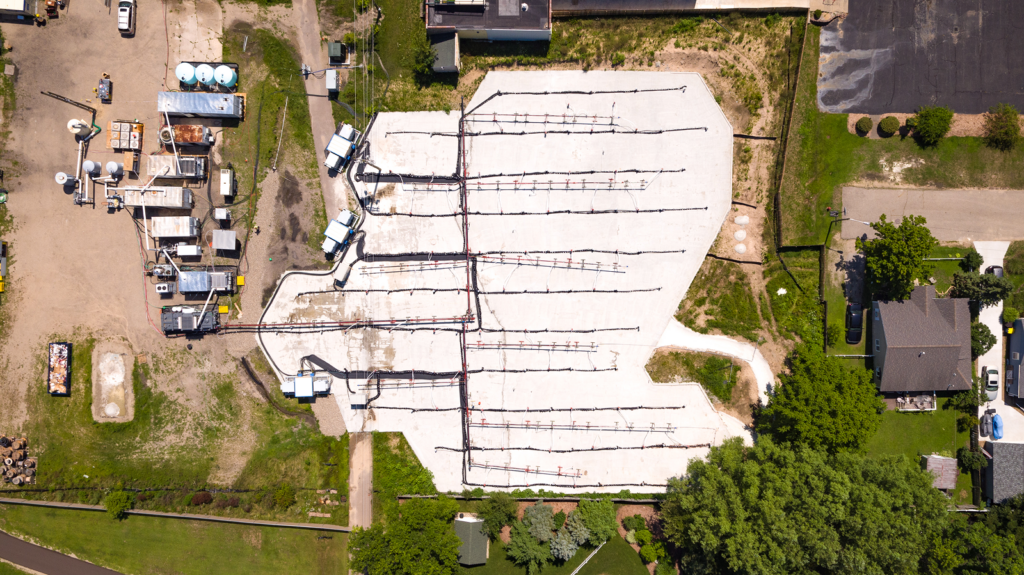
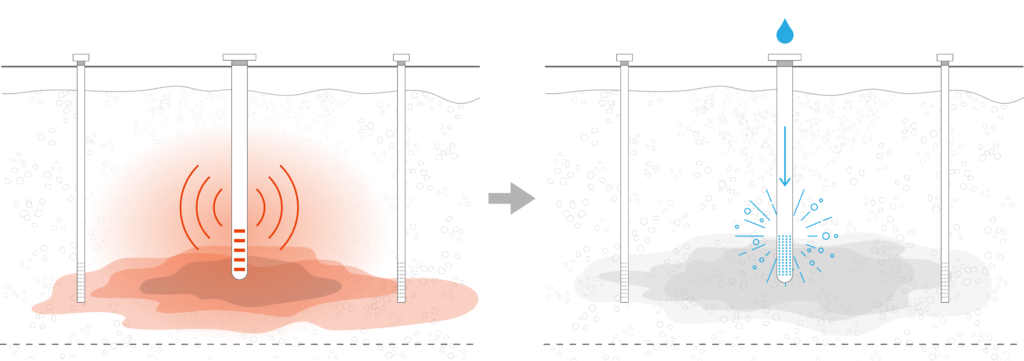
Thermal remediation heats the subsurface to vaporize contaminants, which are then extracted and treated above ground. TCE boils at 87°C but can co-boil with water at a lower temperature VIYA uses three thermal technologies to treat different ground conditions. Electrical Resistance Heating (ERH), including VIYA’s ET-DSP™ process, generates heat by passing electrical current through the ground. Clay-rich soils can conduct electricity more readily than sands due to moisture and dissolved ions, although current flow depends on site-specific conditions. ERH is especially effective in fine-grained soils where TCE can become trapped. Thermal Conductive Heating (TCH), including VIYA’s IT-DSP™ technology, transfers heat into the ground through heated elements. It works well in dry soils, tight formations, and fractured bedrock. Steam-Enhanced Extraction (SEE) injects steam to heat more permeable soils, such as sands and gravels, and mobilize contaminants for extraction. These technologies can be used alone or together to address challenging subsurface conditions.
ISCO injects an oxidant, typically permanganate, activated persulfate or catalyzed hydrogen peroxide, which destroys TCE on contact. It works when the oxidant can reach the contaminant. In permeable sands that is straightforward; in clay or where DNAPL is pooled, the oxidant tends to flow around the problem.
Five questions that decide the choice
Question | Points toward thermal | Points toward ISCO |
What is the geology? | Complex geology. Sand, clay, silt, interbedded or fractured layers | Uniform sands and gravels |
Is DNAPL present? | Yes, or high source mass | No, or mostly dissolved phase |
How fast must the site close? | Months; property transaction or redevelopment deadline | Years are acceptable |
How deep is the source? | Deeper or below structures | Shallow and accessible for injection |
How should spending be spread? | One larger upfront investment | Smaller phased injection events |
Thermal Remediation vs. ISCO: When Should You Use Each Technology?
Choosing between in situ thermal remediation (ISTR) and in situ chemical oxidation (ISCO) depends on contaminant type, concentration, subsurface geology, treatment objectives, and project timelines. Both technologies can effectively remediate contaminated soil and groundwater, but they are suited to different site conditions. In some cases, combining thermal remediation and ISCO provides a more effective approach than using either technology alone.
When Is ISTR a Better Fit?
Real-World Example: NASA Marshall Space Flight Center
At NASA’s Marshall Space Flight Center in Alabama, VIYA Environmental used in situ thermal remediation (ISTR) to treat trichloroethylene (TCE) and tetrachloroethylene (PCE) contamination, including dense non-aqueous phase liquid (DNAPL), in silty clay and gravel overlying fractured limestone bedrock. Across three treatment areas, the project recovered more than 63,000 pounds of volatile organic compounds (VOCs) in 273 days of operation—22 times the originally projected contaminant mass recovery. The results demonstrate ISTR’s ability to remove substantial contaminant mass in complex subsurface conditions.
In situ thermal remediation (ISTR) is often the better choice for sites with high contaminant concentrations, significant non-aqueous phase liquid (NAPL) source zones, or aggressive cleanup timelines. It is particularly effective in complex geological conditions, including low-permeability soils, where contaminants can be difficult to access and remove.
Thermal remediation is generally better suited for:
High-concentration source zones: Sites containing substantial masses of chlorinated solvents, including trichloroethylene (TCE) and tetrachloroethylene (PCE).
DNAPL contamination: Sites with significant dense non-aqueous phase liquid (DNAPL) accumulations that are difficult to treat through chemical injection alone.
Low-permeability soils: Clay, silt, and layered formations where ISCO reagents may preferentially flow through more permeable zones.
Time-sensitive remediation projects: Industrial redevelopment or property transactions requiring substantial contaminant mass removal within a relatively short timeframe.
Sites with persistent contaminant rebound: Source zones where contaminants diffuse from low-permeability materials back into groundwater following conventional treatment.
Although thermal remediation typically involves higher upfront costs, its ability to address concentrated contaminant mass and challenging geology can make it more cost-effective over the full project lifecycle.
When Is ISCO a Better Fit?
At a former gas station in southern Nebraska, VIYA Environmental used in situ chemical oxidation (ISCO) to treat groundwater contaminated with benzene, toluene, ethylbenzene, and xylene (BTEX). The project involved injecting catalyzed sodium persulfate across 42 treatment locations, with simultaneous groundwater extraction to improve chemical contact and maintain hydraulic control. Treatment achieved an 85% reduction in BTEX concentrations in the most highly contaminated monitoring wells, demonstrating ISCO’s effectiveness in treating dissolved petroleum hydrocarbon contamination across variable subsurface conditions.
VIYA Environmental — Former Gas Station Case Study
ISCO is often the more economical option for sites with dissolved-phase contamination, low to moderate contaminant concentrations, and permeable soils that allow effective oxidant distribution.
ISCO is generally better suited for:
Dissolved groundwater contamination: Plumes containing chlorinated solvents or petroleum hydrocarbons without substantial remaining NAPL source mass.
Low to moderate contaminant concentrations: Sites where contaminant mass and oxidant demand are manageable.
Permeable geological formations: Sands and gravels that allow injected oxidants to reach the target treatment zone.
Distributed contamination: Groundwater contamination extending across areas where heating the entire treatment zone would be economically impractical.
Projects with limited upfront budgets: Sites where targeted injection programs can meet remediation objectives without the infrastructure and energy costs associated with thermal treatment.
ISCO performance depends heavily on effective oxidant delivery, adequate contaminant contact, groundwater chemistry, and natural oxidant demand. Sites with extensive clay layers or significant NAPL contamination may require multiple injection events or alternative treatment strategies.
When Should Thermal Remediation and ISCO Be Used Together?
A combined thermal remediation and ISCO strategy can be effective when a site contains both heavily contaminated source zones and surrounding areas of lower-concentration groundwater contamination.
Rather than applying one technology across the entire site, remediation professionals can use each method where it provides the greatest benefit.
A combined treatment approach may involve:
Thermal remediation for source-zone treatment: Use ERH or TCH to remove substantial contaminant mass from high-concentration source zones, DNAPL accumulations, and low-permeability formations.
ISCO for residual contamination: After the heated zone has cooled and subsurface conditions have been evaluated, apply ISCO to treat remaining dissolved-phase contaminants or accessible areas outside the thermal treatment footprint.
Post-treatment monitoring: Evaluate contaminant concentrations, groundwater conditions, and potential rebound to confirm that remediation objectives are being met.
This approach may be particularly useful at former industrial facilities, chemical manufacturing sites, and solvent-handling operations where concentrated chlorinated solvent sources contribute to larger dissolved groundwater plumes.
By using thermal remediation for the most challenging source areas and ISCO for suitable residual or downgradient contamination, site owners can potentially reduce overall treatment costs while improving contaminant mass removal and long-term remediation performance.
The Bottom Line: Thermal remediation is typically better suited to concentrated, difficult-to-access contamination, while ISCO is often preferred for lower-concentration contamination that injected oxidants can effectively contact. Combining both technologies can provide a flexible, site-specific remediation strategy when contaminant distribution and subsurface conditions justify a phased approach.
FAQs
Can ISCO treat DNAPL?
It can reduce DNAPL mass, but pooled DNAPL usually needs several injection rounds and carries a higher risk of rebound than thermal treatment.
How long does thermal remediation of a TCE source take?
Heating typically runs for 6-9 months, depending on volume and soil type.
Can thermal remediation be done under an operating building?
Yes. ISTR can be installed beneath or beside structures. Cleburn Street case study: Thermal Remediation Beneath an Overpass
Which costs more?
Thermal usually has a higher upfront cost, while ISCO costs are spread across injection rounds. For large or difficult sources, total cost to closure can favor thermal.
Can thermal remediation and ISCO be used together at a contaminated site?
Yes. Thermal remediation and in situ chemical oxidation (ISCO) can be combined for effective soil and groundwater remediation. Thermal remediation targets high-concentration contaminant source zones, while ISCO treats dissolved contaminants in groundwater plumes. This integrated remediation approach can improve treatment efficiency and support site cleanup goals.