Home > Case Studies > Marshall Space Flight Center (NASA)
Remediation Solution
Remediation Approach
Technology
Contaminant Mass
Recovered
Media Treated
Industry
Contaminant Type
Contaminant of Concern
Location
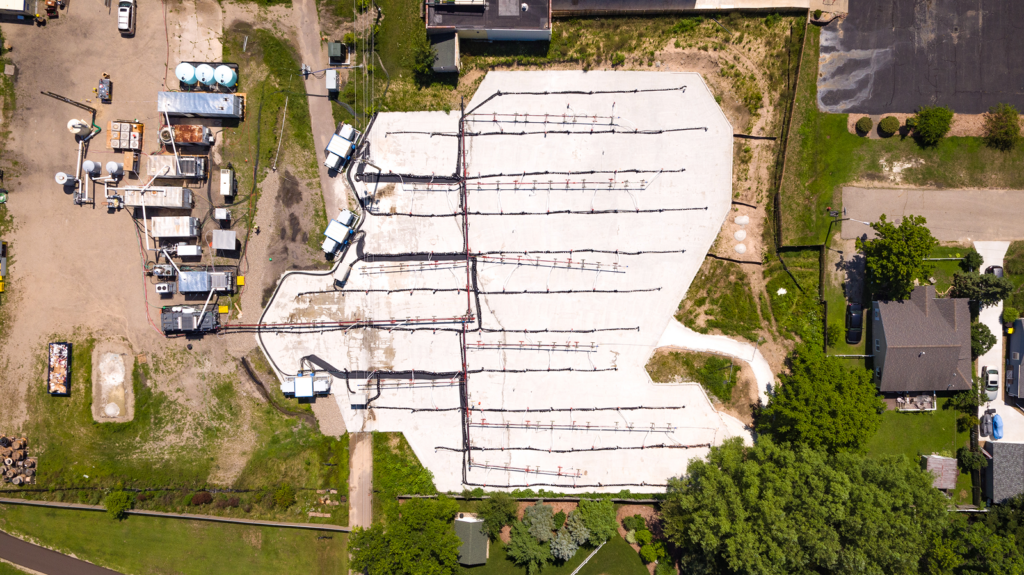
PCE and TCE contamination in silty clay and gravel overlying limestone bedrock at NASA’s Marshall Space Flight Center in Alabama required treatment in a high-security environment with DNAPL penetration into fractured bedrock, unmarked underground utilities, and strict facility access protocols. The complex geology necessitated an integrated multi-technology thermal approach.
An integrated In-Situ Thermal Remediation (ISTR) system was designed and implemented combining IT-DSP™ (Inductive-Thermal Dynamic Stripping Process), ET-DSP™, and SEE for the first time on a single project. The system was engineered to address the distinct heating requirements of the silty clay overburden and fractured bedrock units across three separate treatment areas.
Uniform heating above 194°F was achieved, with peak temperatures of 220°F. Over 273 days of operation with greater than 99% system uptime, more than 63,016 lbs of VOCs were removed, 22 times more than originally projected. This project marked the first application of all three ISTR methods simultaneously at a single site.

Superfund ISTR Under Strict Air Emission Limits
Bioremediation for PFAS
High-Profile ISTR of Historic Chemical Disposal Impacts
Explore real-world remediation projects where VIYA’s technology-agnostic approach, field expertise, and integrated treatment strategies have been applied to complex site conditions. Browse case studies by contaminant, technology, industry, and project type to see how tailored solutions translate into measurable results.