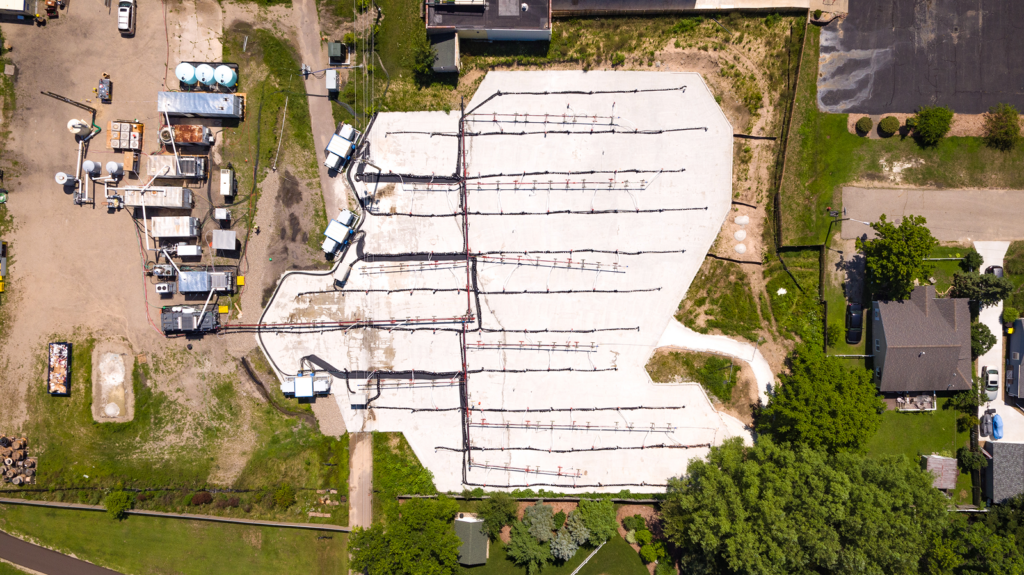
Former Wood Preserving Superfund Site

Removing Legacy Creosote DNAPL Contamination with ET-DSP™

Remediation Solution

Remediation Approach

Technology

Volume Treated

1,000 cubic yards

Contaminant Mass
Recovered

4,680 lbs of creosote and related hydrocarbons

Media Treated

Soil and groundwater; low-permeability soils with limited fluid movement

Industry

Contaminant Type

Contaminant of Concern

PAHs, Creosote, NAPL, DNAPL, LNAPL

Location

North Carolina,
USA

Challenge

The former Cape Fear Wood Preserving facility produced creosote-treated wood from 1953 to 1978. Process wastes went to a concrete sump, and separated liquids drained through a ditch to a diked pond. This left soil and groundwater impacted with creosote, PAHs, and NAPL.

EPA Region 4 needed a pilot to show whether thermal treatment could recover DNAPL from one of the most heavily impacted areas before full-scale remediation was designed. The pilot zone covered about 1,600 ft² from 9 to 26 ft bgs, roughly 1,000 yd³ with an estimated 3,900 lbs of creosote in place.

Site conditions worked against recovery:

  • Resistive soils. Laboratory testing measured static resistivity of 50 to 125 Ω·m. This limits current flow and makes electrical heating harder.
  • Layered, heterogeneous geology. Fine to medium sand beds 1 to 5 ft thick are interbedded with clayey sands and clays above a continuous 15 ft semi-confining clay unit.
  • Persistent, high-boiling contaminants. Creosote SVOCs need sustained heat to mobilize and are chemically aggressive to standard well and sensor materials.
  • Nearby receptors. A residential subdivision of about 1,000 people sits a quarter mile south, and upper aquifer flow is radial. Any mobilized NAPL had to stay contained.

Site Conditions

  • LNAPL
  • Mixed Contaminants
  • Risk & Regulatory
  • DNAPL
  • Large Plume

Approach

VIYA (formerly McMillan-McGee) was contracted to design, install, operate, and demobilize the in-situ thermal remediation system using ET-DSP™ electrical heating technology for the pilot. The technology heats soil by passing electrical current between electrodes. At the same time, water circulated through each electrode carries heat outward and keeps the surrounding soil conductive. The result is uniform heating, even in resistive, layered soils where conventional methods struggle.

  • Bench-scale testing. Laboratory testing on site soils confirmed that thermal treatment could mobilize creosote and shaped the pilot design.
  • Targeted pilot deployment. A compact array of nine electrodes and four multi-phase extraction wells was installed in one of the most heavily impacted areas of the site.
  • Soil conditioning. A dilute saline solution delivered through the electrodes improved conductivity in the resistive soils and sped up heating.
  • Controlled extraction. Mobilized vapor and liquid were captured through the extraction wells while the system maintained inward flow to prevent contaminant spreading.
  • Real-time monitoring. A network of digital temperature and pressure sensors fed a secure web platform, giving the project team continuous visibility into subsurface conditions.

Results

The ET-DSP™ pilot recovered 4,680 lbs of creosote and hydrocarbons from the site. Uniform heating across the full treatment volume mobilized contaminants trapped in resistive, heterogeneous soils. The treatment zone reached the 90°C target temperature on day 64 and held it through the end of operations. All thermal goals were met on schedule and under budget.

  • 4,680 lbs of creosote and hydrocarbons recovered
  • 25 million scf of soil vapor extracted
  • 96.4°C peak average treatment temperature

The pilot results informed a phased, four-stage design for full-scale remediation across the site.

Related Case Studies

Learn What’s VIYABLE

Let's Begin Your Path Forward.