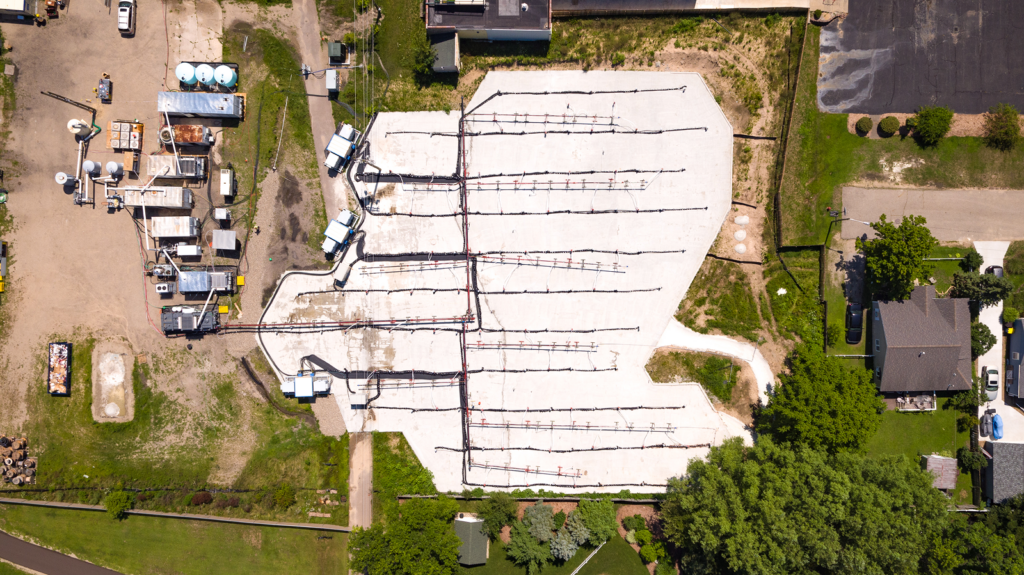
Hockessin Groundwater Site

Below-Grade ERH Beside an Active Dry Cleaner

Remediation Solution

Remediation Approach

Technology

Volume Treated

1,085 yd³

Contaminant Mass
Recovered

523+ lbs

Media Treated

Soil & Groundwater: Silt, clay, and sand overburden on Cockeysville Formation bedrock

Industry

Contaminant Type

Contaminant of Concern

PCE, TCE

Location

Delaware,
USA

Challenge

The Hockessin Groundwater Site, added to the Superfund National Priorities List in 2018, covers about 32 acres along State Route 41 in Hockessin, Delaware. A PCE plume there had reached the aquifer that supplies local drinking water. Under a 2019 Action Memorandum, EPA selected in situ thermal remediation to cut off the source: PCE, TCE, and 1,1-DCE in 1,085 yd³ of soil beside an active dry cleaner. The source zone sat beneath a busy shopping-plaza parking lot, with groundwater at about 20 ft and bedrock near 24 ft. Treatment had to keep the business and its parking open, keep vapors out of the occupied building, and protect a telecommunications line crossing the work area.

Site Conditions

  • Mixed Contaminants
  • Fractured Bedrock
  • Active Facility

Approach

ET-DSP™ electrical resistance heating passed current between 28 electrodes, double-stacked at 14 locations, to heat the source zone from about 3.5 to 26 ft below grade. Water circulated through each electrode spread heat by convection. Three rounds of potassium chloride injection boosted power in the more resistive unsaturated soils near the surface. Seven multiphase extraction (MPE) wells recovered vapor and groundwater for treatment through vapor-phase granular activated carbon. Extracting more water than was injected held hydraulic control of the treatment zone.

Every wellhead, pipe, and cable ran below grade in vaults and trenches beneath an insulating concrete vapor cap, so the parking lot stayed in use. Horizontal wells beneath the building slab were installed to intercept fugitive vapor. An automatic quench system held the telecommunications line below its 170°F rating, and an engineered grounding system kept step and touch voltages below the 15-volt safety limit throughout. VIYA (then McMillan-McGee) designed, installed, and operated the system under contract with a prime contractor on the EPA removal action.

Results

The treatment zone reached its 194°F (90°C) target on September 16, 2021, and the daily site average peaked at 205°F (96°C) in November. Over 197 days of heating, the system recovered about 523 lbs of CVOCs, with no DNAPL observed. Heating ended on December 22, 2021, once mass removal had held below 5% of its peak rate for two weeks. Indoor air in the dry cleaner stayed non-detect for PCE throughout. Energy use of 707 MWh came within 8% of the 655 MWh design, and ET-DSP™ uptime was 97.9%.

Related Case Studies

Learn What’s VIYABLE

Let's Begin Your Path Forward.