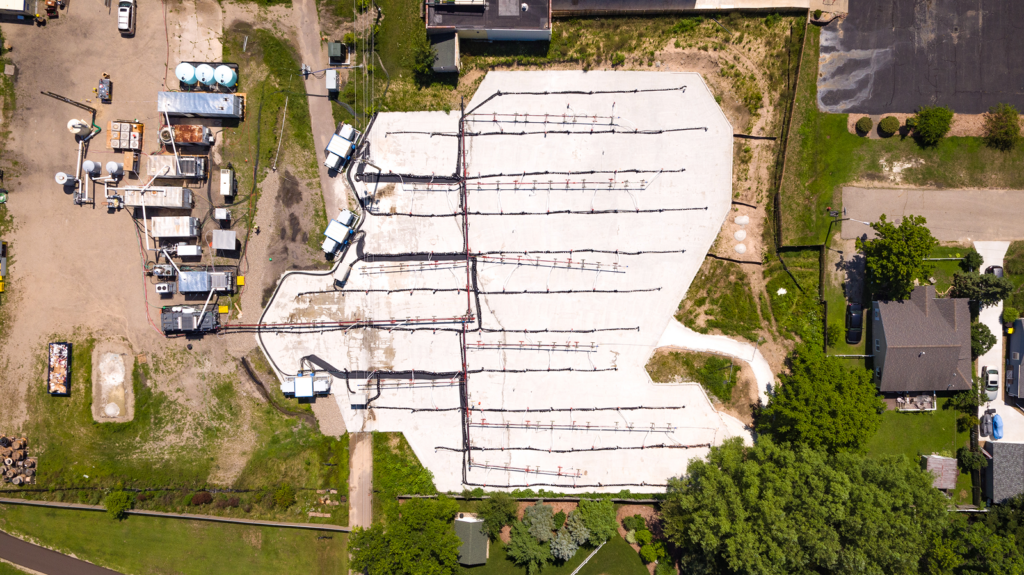
The former Cape Fear Wood Preserving facility produced creosote-treated wood from 1953 to 1978. Process wastes went to a concrete sump, and separated liquids drained through a ditch to a diked pond. This left soil and groundwater impacted with creosote, PAHs, and NAPL.
EPA Region 4 needed a pilot to show whether thermal treatment could recover DNAPL from one of the most heavily impacted areas before full-scale remediation was designed. The pilot zone covered about 1,600 ft² from 9 to 26 ft bgs, roughly 1,000 yd³ with an estimated 3,900 lbs of creosote in place.
Site conditions worked against recovery:
- Resistive soils. Laboratory testing measured static resistivity of 50 to 125 Ω·m. This limits current flow and makes electrical heating harder.
- Layered, heterogeneous geology. Fine to medium sand beds 1 to 5 ft thick are interbedded with clayey sands and clays above a continuous 15 ft semi-confining clay unit.
- Persistent, high-boiling contaminants. Creosote SVOCs need sustained heat to mobilize and are chemically aggressive to standard well and sensor materials.
- Nearby receptors. A residential subdivision of about 1,000 people sits a quarter mile south, and upper aquifer flow is radial. Any mobilized NAPL had to stay contained.